
The Robert Anderson Trust provided me with a truly transformative experience: the opportunity to immerse myself in the world of Egyptology, turning my academic dreams into reality. I am sincerely grateful for the Trust’s investment in my future academic endeavours and for making this invaluable experience possible. My heartfelt appreciation extends to Dr Chris Naunton, the Director of the Robert Anderson Research Charitable Trust, for his unwavering support, flexibility, and warm welcome, which played a crucial role in ensuring a smooth and enriching research scholarship in London.
 In the study room in the Department of Egypt and Sudan, British Museum
During my month-long scholarship in November 2023, my focus was on the ‘Study and Publication of the Artifacts from The Excavation in front of the first pylon at Karnak Temples.’ The primary objective was to directly examine collections of materials relevant to my research, with a particular emphasis on the terracotta figurine groups from Naukratis housed in the British Museum.
My journey led me to the Department of Egypt & Sudan at the British Museum, where I undertook several intensive sessions in the study room. Through a careful examination of the figurines from Naukratis, I was able to appreciate the intricate craftsmanship embedded in each artifact. A serendipitous meeting with Dr Aurélia Masson-Berghoff, Co-Investigator of the Naukratis: Greeks in Egypt project and a member of the Departments of Greece and Rome and Egypt and Sudan at the British Museum, proved to be a pivotal moment. Our enlightening discussions enriched my research with valuable insights into the historical and cultural contexts of Naukratis and the Greco-Roman settlements, profoundly influencing the course of my scholarly journey.
The extensive library resources at the Department of Egypt & Sudan provided me with a plethora of specialized literature, which allowed me to place the artifacts within their historical context. This knowledge was indispensable for a nuanced analysis, enabling me to draw compelling parallels between the Greco-Roman terracotta figurines from the settlement at Naukratis and those from the Karnak Temples.
In addition to my work at the British Museum, my research expanded to include the Petrie Museum. There, I had the privilege of studying a diverse array of artifacts, including terracotta figurines, faience amulets, and bronze statues of Osiris from both Memphis and Naukratis. These experiences significantly widened my research perspective, revealing the complex interplay of cultures in ancient Egypt.
 At the Petrie Museum
Furthermore, the resources available at the EES Library and UCL Library of Egyptology played a crucial role in enhancing my scholarly pursuits. Access to specialized literature not only deepened my understanding of historical and archaeological contexts but also complemented the hands-on examination of artifacts, providing a well-rounded and comprehensive approach to my research.
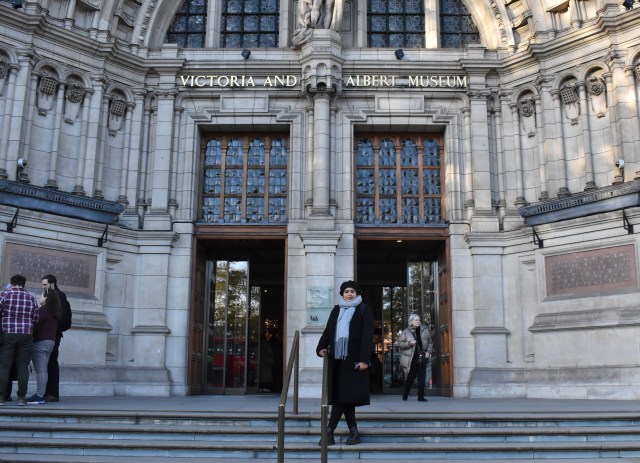 Outside the Victoria and Albert Museum
My time in London was not solely dedicated to academia; it was also marked by exploration and cultural immersion. Iconic landmarks such as the London Eye, Big Ben, Buckingham Palace, and visits to the Victoria and Albert Museum, National Gallery, Museum of Natural History, and the Design Museum contributed to a holistic understanding of London’s historical and artistic tapestry.
The Trust’s Kensington house provided a conducive atmosphere for work, fostering a productive environment. It also offered a unique opportunity to meet music scholars from diverse backgrounds, creating a pleasant space for intellectual exchange and networking.
 Dinner in Kensington with the other residents at the Trust’s house on Hornton Street
In conclusion, the Robert Anderson Trust scholarship has been instrumental in facilitating both academic exploration and cultural immersion. This scholarly adventure has left an indelible mark on my academic pursuits, and I am profoundly grateful for the invaluable support that made this enriching experience possible.
 The Robert Anderson Trust