
Eman stayed at the Trust’s Kensington house during October 2024.
During my one-month academic visit to London, I engaged in research and professional exchanges to enhance my understanding of ancient Greek texts and Conservation methods. My activities included research at prominent institutions related to my field of study, communication with specialists, engaging with the community through some activities, and exploring various museums and city landmarks.
 Outside the British Library
The main purpose of my visit was to study papyrus no. 2118 from the manuscript collection of the BL. After obtaining the reader pass, I got access and could examine the materials firsthand, focusing on aspects such as handwriting, texture, and historical context.
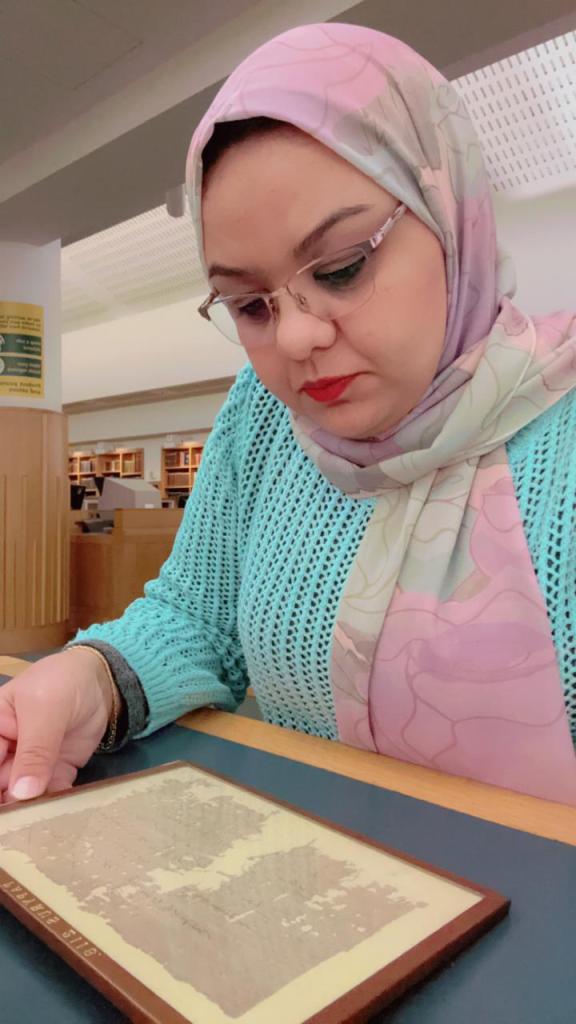 Examining papyrus no. 2118 in the British Library
In addition, I got the opportunity to examine other original handwriting material (Ostracon 25864) that is related to the study of the main papyrus text. My time in the library wasn’t spent only on examining the material but also reviewing the newest books about papyri in general and valuable resources in the field of conservation and classics. This close study provided unique insights into the textual traditions and material culture of the ancient world, contributing significantly to my research.
At the Library of the Institute of Classical Studies I accessed a wealth of resources on ancient Greek and Roman studies. The library’s extensive collection of texts and journals offered critical insights into the cultural, social, and political contexts of classical antiquity. I found valuable comparative literature and scholarly interpretations that deepened my understanding of the texts I studied at the British Library. During my visit, I was also gifted periodicals from the institute, which were a meaningful addition to my research materials.

In the library of the Institute of Classical Studies
The library at University College London’s Institute of Archaeology provided me with essential resources on archaeological methods and material culture. I consulted recent publications on document conservation and analysis, enriching my research on the conservation. This environment also facilitated meaningful conversations with researchers, allowing me to integrate diverse perspectives into my work.
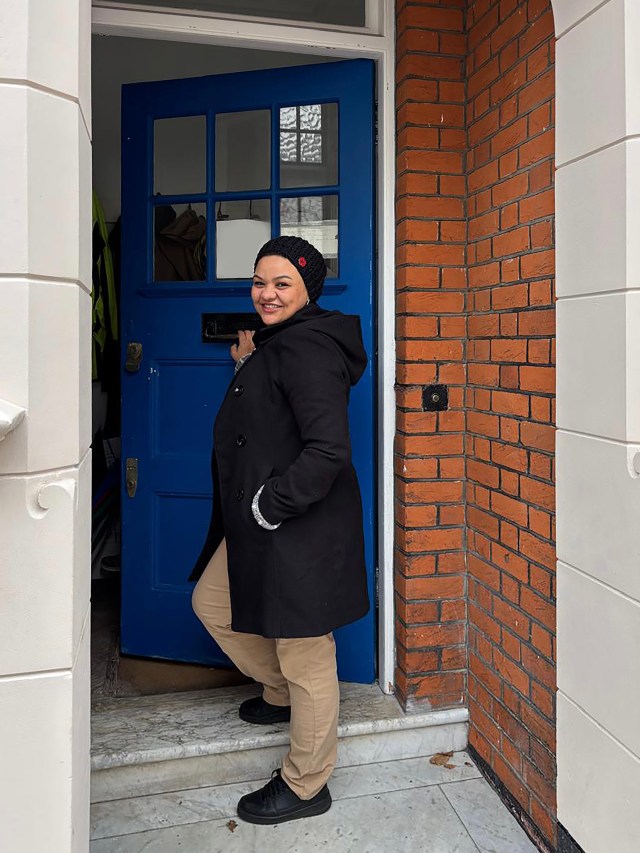 At the front door to the Trust’s house in Kensington
Dr Anderson’s library at the house in Kensington provided an unexpected opportunity that complemented my interest in papyri. This special library provided rare texts and scholarly works that are difficult to find in my home institution and I found Dr Anderson’s collection to be both insightful and inspiring. This experience offered a fresh perspective on private collections as valuable resources for academic inquiry.
During my time in London, I engaged in productive on-site communications with conservators and curators at the British Library’s conservation lab, the Petrie Museum, and the Egypt Exploration Society. We exchanged ideas on conservation practices and interpretations of ancient materials, while online communications with specialists from the British Museum, the Victoria and Albert Museum, and other institutions were also valuable. These discussions provided practical knowledge and alternative perspectives on conservation techniques in general.
 With Dr Anna Garnett and colleagues from Sudan at the Petrie Museum of Egyptian Archaeology, UCL
Additionally, I attended a lecture by Egyptologist Salima Ikram at the British Museum, where she discussed recent advancements in understanding mummification practices in the ancient world. I also enjoyed a night concert for friends at Anderson’s residence, also I have a wonderful opportunity to reconnect with friends from Sudan who are currently residing in Cambridge. Beyond my research, I visited various historical sites and took time to explore London’s landmarks. Walking through the gardens and along the Thames provided valuable moments of reflection, allowing me to fully appreciate the city’s unique blend of history, culture, and natural beauty.
 Alvin Arumugam of the Clio Project (and a resident at the Trust’s house in Kensington) conducting a concert at St Peter’s Church, Notting Hill.
 Looking out across the Thames towards Westminster Bridge and the Houses of Parliament
For more information about the other students in the 2024 cohort please see here.
 The Robert Anderson Trust