
Islam, of Ain Shams University, Egypt spent November 2025 in London working on ‘Publishing an Anthropoid Wooden Coffin from the Late Period at the Egyptian Museum, Cairo’.

In the study room of the Department of Ancient Egypt and Sudan at the British Museum
I am deeply grateful to The Robert Anderson Trust for providing me with this invaluable opportunity to undertake my research in London. Their support has made it possible for me to access unique resources, engage with leading scholars, and advance my study of anthropoid wooden coffins from the Twenty-fifth and Twenty-sixth Dynasties. This visit represents a significant step forward in my academic development and enables me to contribute meaningfully to the understanding of ancient Egyptian funerary practices.
During my stay, I visited several key institutions, including the British Museum and the Petrie Museum of Egyptian Archaeology. At the British Museum, I studied eight objects, including four complete anthropoid wooden coffins, which provided crucial parallels for my ongoing research on an unpublished coffin in the Egyptian Museum, Cairo. The Petrie Museum offered additional reference material, particularly the coffin LDUCE-UC14230, which allowed me to examine stylistic and iconographic features in detail. These hands-on experiences were essential for comparing iconography, inscriptions, and artistic features across different collections.
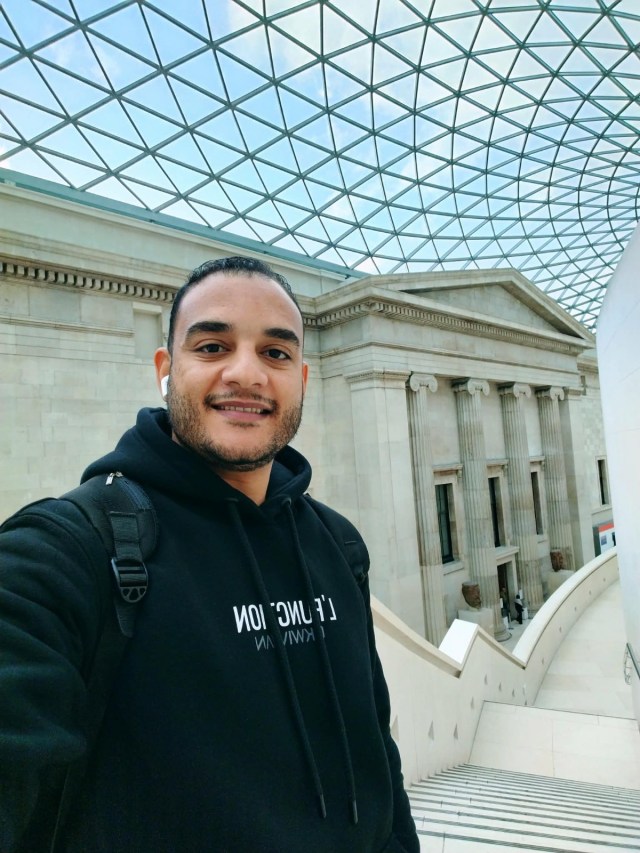
In the Great Court at the British Museum
In addition to museum work, I consulted key academic resources at the British Library and other libraries in London. These visits enabled me to access important references critical to my research. Beyond the academic focus, I explored several of London’s renowned landmarks, cultural institutions, and beautiful gardens, such as Hyde Park, the Victoria and Albert Museum, the Natural History Museum, Cleopatra’s Needle.
This opportunity greatly supported my academic development. It allowed me to work with primary sources, collaborate with experts, and expand my network in Egyptology. The knowledge gained will inform my future research and teaching, enhancing my contribution to the study of ancient Egyptian material culture and funerary practices.
For more information about the other students in the 2025 cohort please see here.
 The Robert Anderson Trust