
Dr Mona stayed at the Trust’s house in Kensington for the month of October 2025.

Investigating Late Period stelae in the Petrie Museum
I would like to express my deep respect and thanks to the Robert Anderson Trust for hosting me in their house while I gathered material for my post-doctoral research subject. As an archaeologist at Karnak temples, this extended stay in London was a unique opportunity to study with my own eyes museum collections that I usually get used to access through online catalogues.
Respecting the rules I had first to contact several museums in England, to ask for appointments to study and photograph the un-exhibited artefacts that are ascribed to the 28-29th Dynasties of ancient Egypt, a period in which ancient Egypt suffered from many historical fluctuations and unrest.
The work in the British museum study room at the department of Egypt and Sudan was very flexible, they provided me all the material I asked to study and helped me also with some tools that facilitate the photographing process, thanks to Adriana the librarian, Marcel Marée and Aurelia Masson-Berghoff, both curators in the department with whom I discussed several aspects of my research and who provided me with several useful books.
Lisa Randisi, the curator at the Petrie museum of Egyptian archaeology was very helpful, providing me with the material I asked to study, allowing me to see also their important collection of Late Period papyri. The Ashmolean museum was also one of my priorities to visit, as this museum contains many objects ascribed to the Late period, especially small artefacts.
Several types of artefacts were examined and documented to allow me to understand the artistic changes that characterised this period e.g. a limestone stela, steatite scarabs that are inscribed on their backs with animals figures and predecessor-kings names – showing archaism – a statuette of Heker that is missing its head, a faience green glazed ushabti of Nepherites which was probably from his tomb that was found 1996 in Mendes (Tell el-Ruba), and other ceramic artifacts.
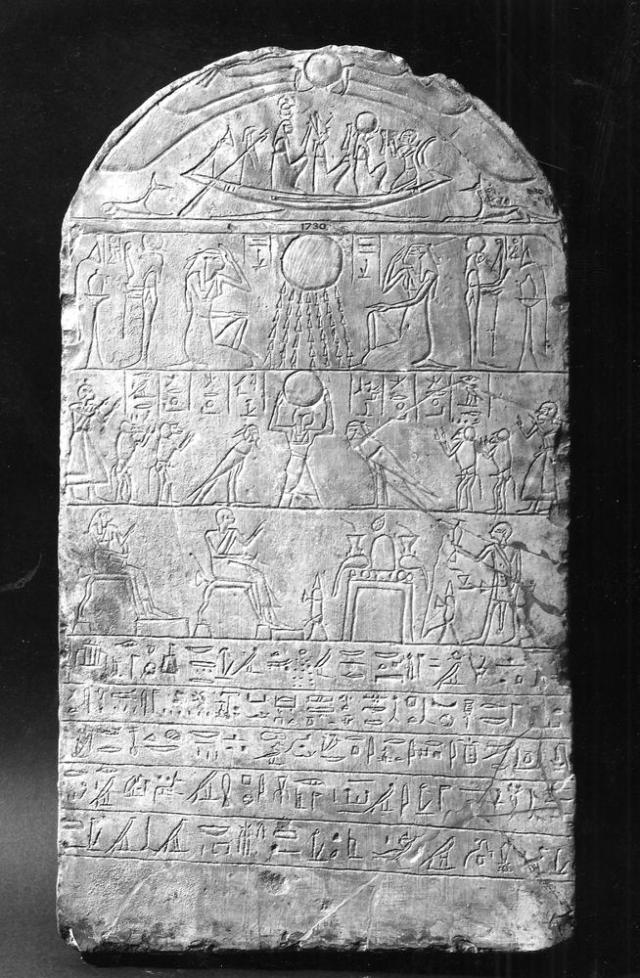
British Museum EA 1730. Round-topped limestone stela of the 28th Dynasty. For further information see here. © The Trustees of the British Museum
The Petrie Museum contains small artefacts on display and in storage that resemble the small objects I studied in the British museum. Unfortunately, many of these were unprovenanced.
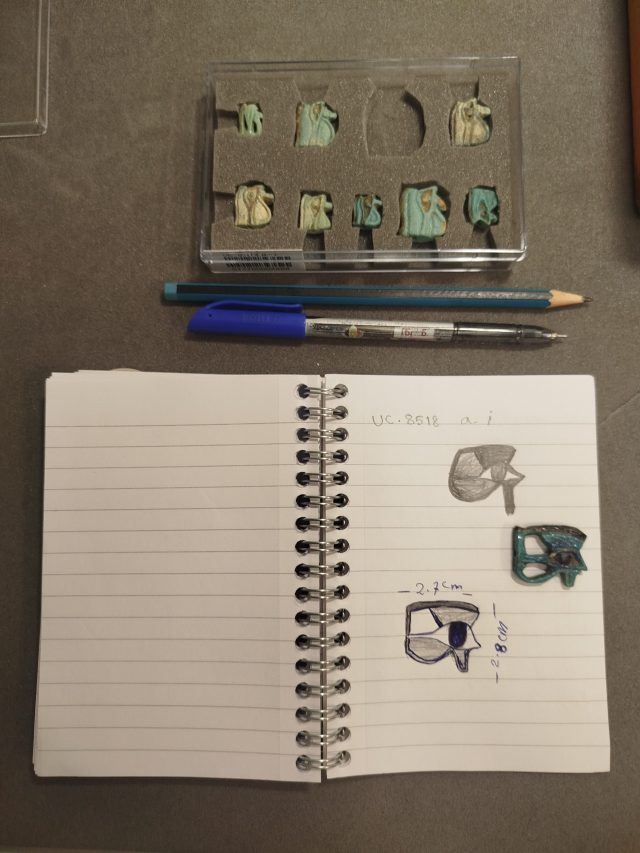
Some of the artefacts studied at the Petrie Museum
A database was designed on Filemaker to collect all these artefacts to design a catalogue later to distinguish the artistic frame of this period.
Last but certainly not least, a major benefit of research trip is of course getting the chance to interact with the local community of researchers and colleagues and I was able to meet colleagues from Egypt and other countries who were participating in the the British Museum’s International Training Programme (ITP) at the last day’s training event to which I had been invited.
For more information about the other students in the 2025 cohort please see here.
 The Robert Anderson Trust