
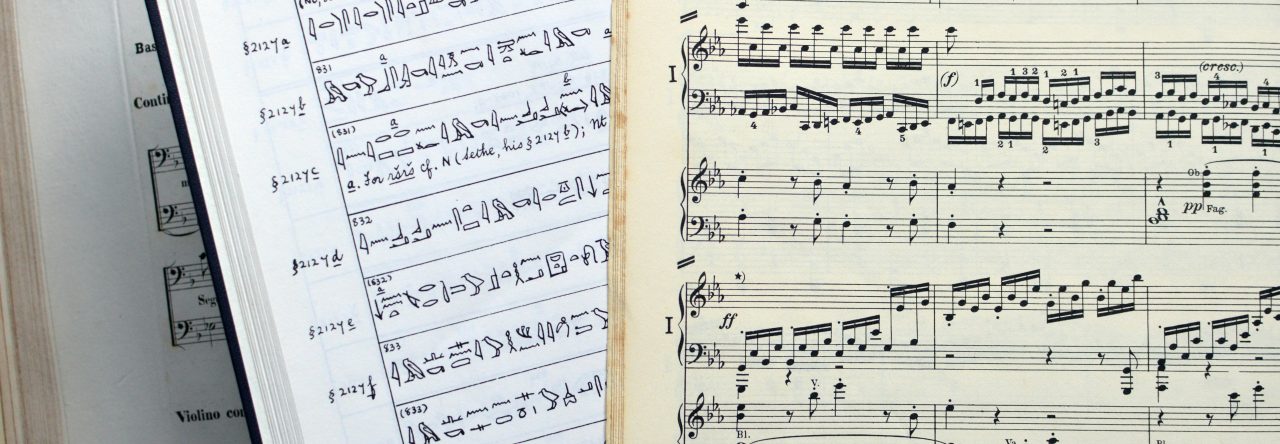
When the Trust’s Founder Dr Robert Anderson died in 2015 he left behind a wonderful legacy: of numerous articles, reviews and books on music, Egyptology and archaeology; of the hundreds of students and others he taught or mentored himself; and of the many more who have been supported by his Trust from its foundation in 1988 down to the present day.

Dr Anderson at Deir el-Bahri, Egypt
Robert also left all his possessions to the charity, including, most importantly, two houses in London which are now used to accommodate students and scholars from overseas. He also left behind a very substantial collection of books which line the walls of the rooms in his former home on Hornton Street in Kensington.
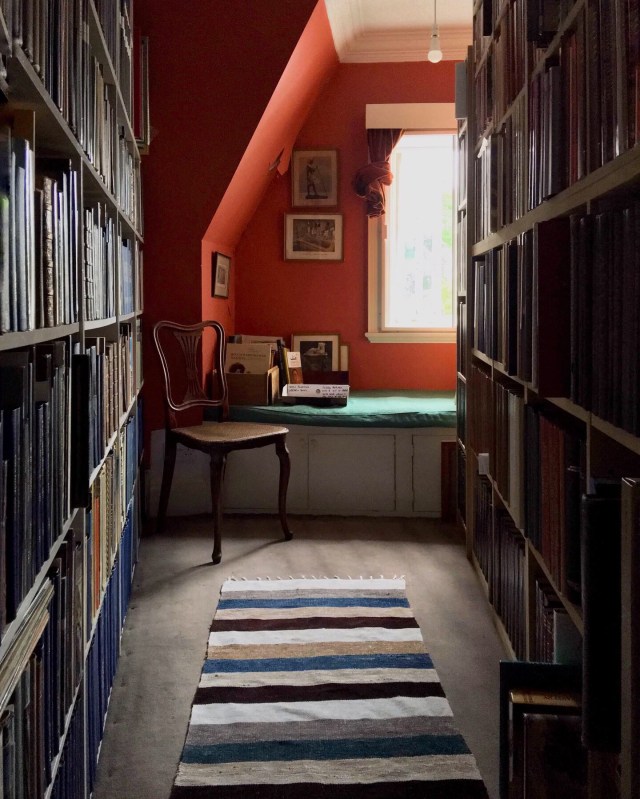
Part of Dr Anderson’s Egyptological library in his former home in Kensington
Some of these books are rare and fragile, most notably Robert’s copy of the second edition of the Description de l’Égypte, the monumental survey of Egypt’s natural environment and its buildings both modern and, most importantly for Robert, ancient.
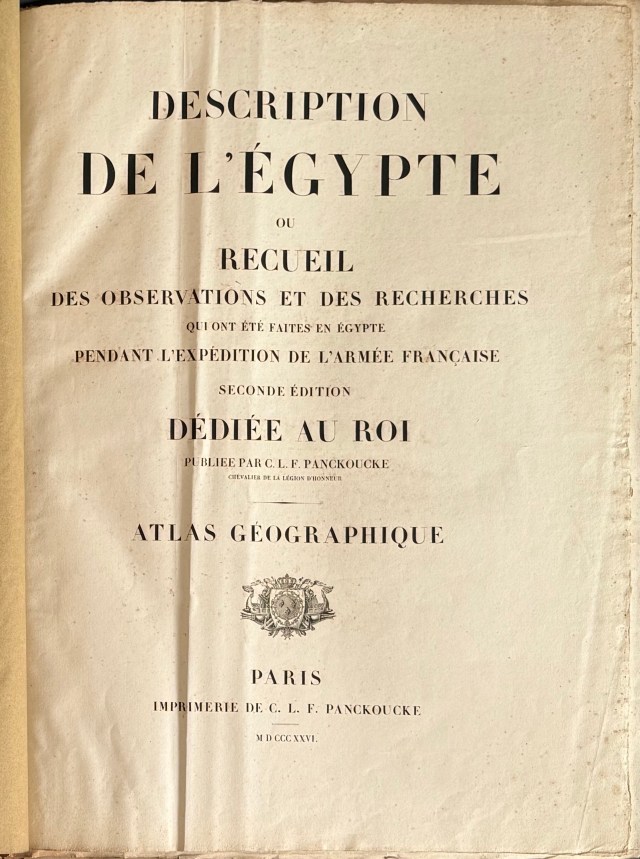
Title page of one of the volumes formerly in Dr Anderson’s collection
Robert had a particular interest in the Description and the Napoleon’s expedition to Egypt in 1798 from which it arose, and he wrote two books on the subject himself: Egypt in 1800, co-authored with Ibrahim Fawzy (1987), and The French in Egypt (forthcoming). He explained his motivation for writing the second of these as follows:
“It was a memorable occasion when, on my way to the British Museum, I looked in at Bernard Weinreb’s bookshop on the corner of Gower Street and Great Russell Street and found a copy of the Description de l’Égypte. It was the second edition, published between 1821 and 1830 by Charles Panckoucke. I reserved the copy at once and, after urgent consultation with my finances, decided to buy it. The 11 folio volumes, five of them devoted to antiquities, gradually became too heavy for me to lift. Among the 24 text volumes, nine concerned with ancient Egypt, there are still many uncut pages. The plates had given me so much pleasure over the years that it seemed right I should attempt to give some impression of the original French text.”
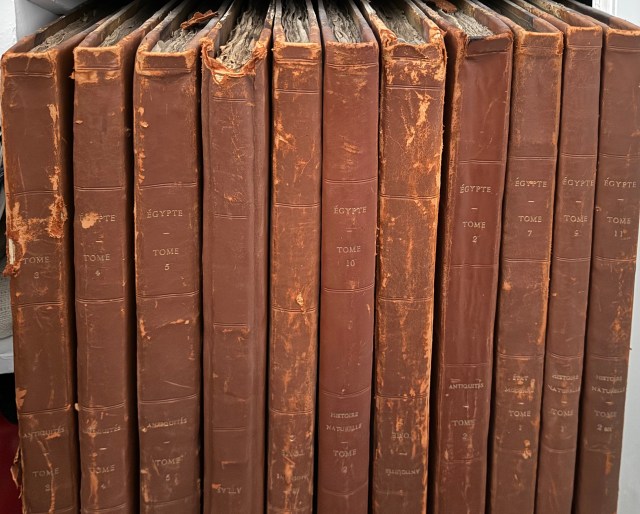
Some of the plates volumes of the Description while still on the shelves at Hornton Street
For many years we have felt that the volumes lent a prestige to the small Egyptological library at Hornton Street. However, they have been kept in inadequate conditions, stored upright on open shelves in a room which has mostly been used as a bedroom. Being so rare and fragile, unwieldy and inaccessible, it has been impossible for any of our visiting Egyptologists to use them, much as they might have admired them. The Description is readily available online (e.g. via the Library of Congress, here) so consulting the originals is unnecessary.
The Trustees recognised that such important items should be looked after more properly, but did not feel able to commit the Trust’s limited resources for this purpose as it falls outside its remit to support talented young people. Instead the volumes are now to be sold at auction by Sotheby’s, and the proceeds will be put towards the Trust’s programme of charitable activities.
The auction, ‘Books, Manuscripts & Music, from Medieval to Modern’ will be conducted online. It opens for bidding on Thursday 25 June at 1pm and closes on 9 July.
The entry for the Description is here. In addition three further titles of similar age and importance from Dr Anderson’s collection are also offered for sale as follows:
Lepsius, Denkmäler aus Ägypten und Äthiopien
Robert Adam, Ruins of the Palace of the Emperor Diocletian
Robert Wood, Ruins of Palmyra
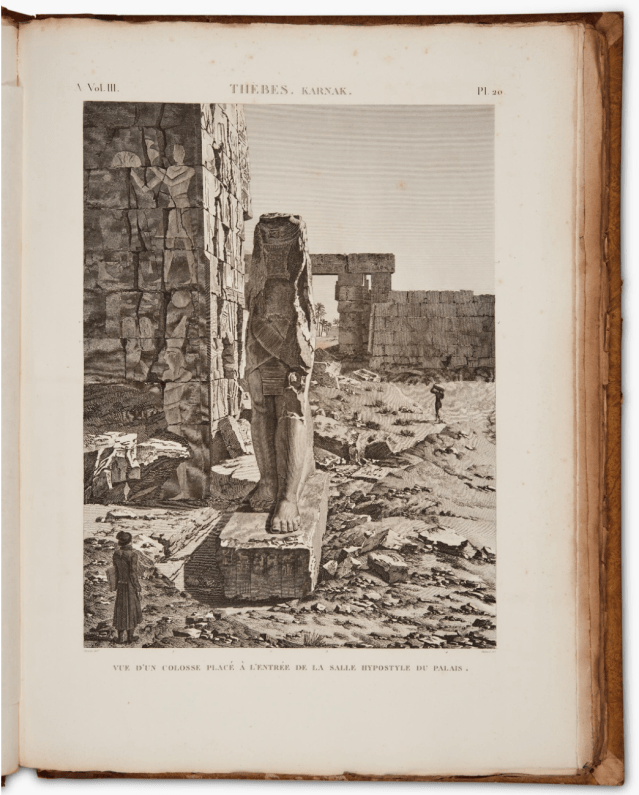
An illustration of a colossal statue at Karnak as it appears in the Description de l’Égypte
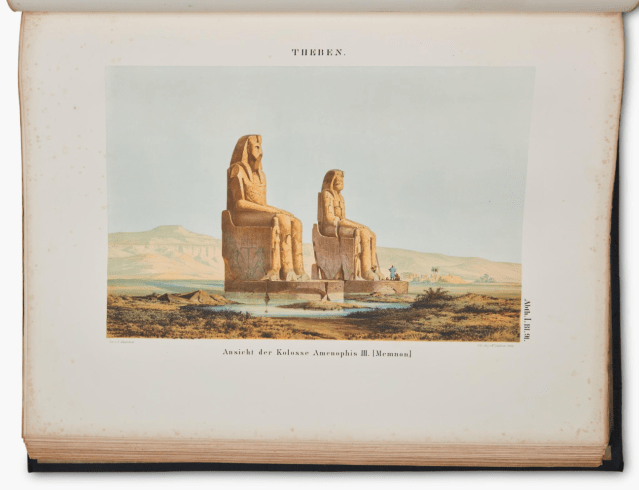
The Colossi of Memnon as seen by Lepsius’ artists and published in his Denkmäler
A short biography of Dr Anderson appears alongside all the lots. The Trustees will be considering how best to make use of the proceeds and an announcement will be made here in due course.


Thank you for the update. I met Robert in Egypt in the early part of 1990. He was on a Nile Cruise as a paid expert and I was backpacking around the country. We only met for a moment, but I told him I had just finished University in the USA, so he liked me. I told him I hoped to live and work in London in the near future, he said; “You can stay with me. I’m sure you’ll find a job – British people don’t want to work.” The long story short is he put me up for about 4 months and we became lifelong friends. At one point he was going up to Scotland for 3 weeks and I asked if I should find somewhere else to stay. He was offended at my question and he left the whole house to me for that time. Before email he used to type out very amusing aerograme letters to me. Your message about the books reminds me of what an interesting fellow he was. I still think about him often and miss him.
*
Dennis Conway
Get Outlook for Androidhttps://aka.ms/AAb9ysg
LikeLike