
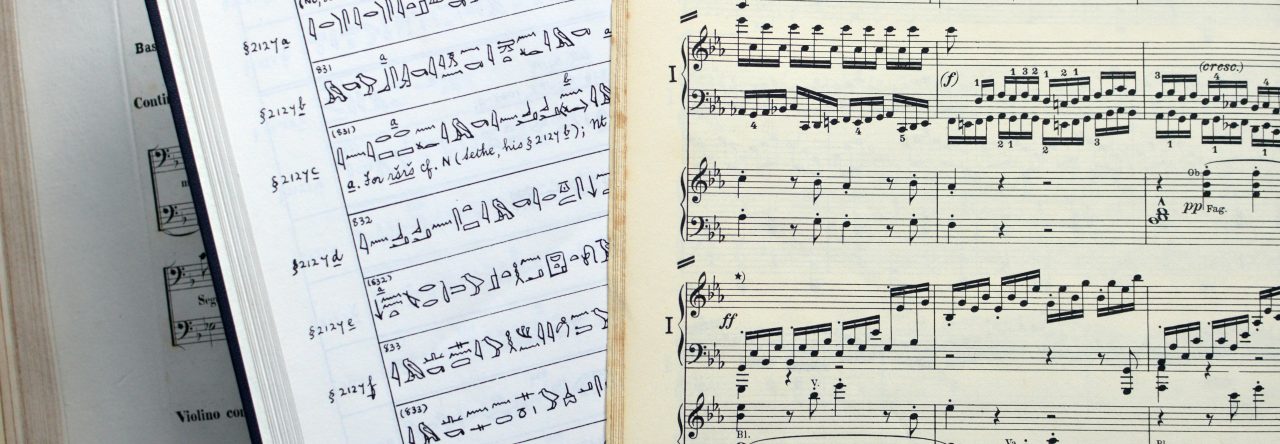
In September 2026, I had the privilege of staying in Kensington—generously supported by the Robert Anderson Trust—to conduct important research for my dissertation. I am more than grateful for this opportunity. My stay in London significantly advanced my work and provided deep insight into the subject matter—insights that would have been scarcely possible otherwise. The title of my dissertation is “Architecture in Motion: Ancient Egyptian Structures as ‘Image Vehicles’ in Great Britain.” My research focuses on Egyptian architecture and its influence on British art and culture as ‘image vehicles’.
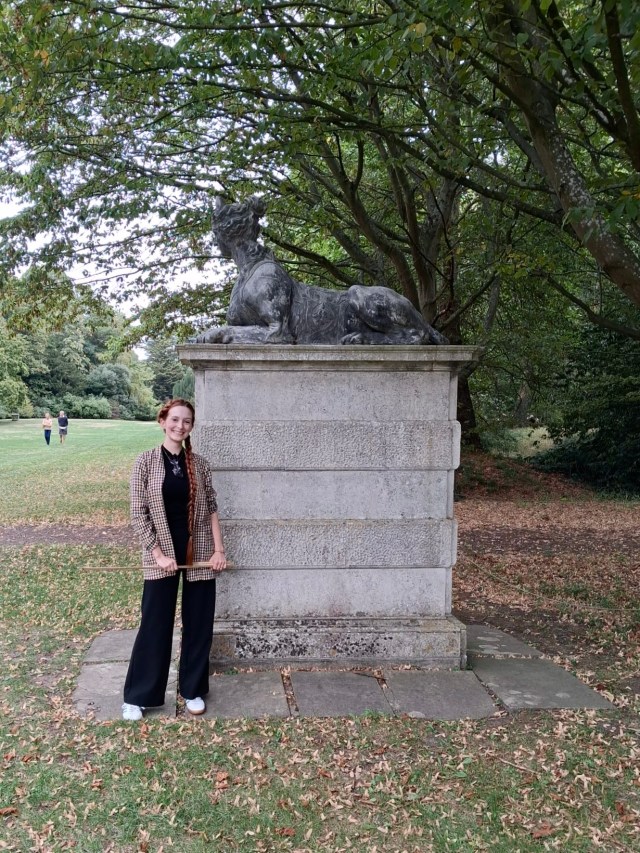
Visiting a sphinx at Anglesey Abbey, Cambridgeshire.
The primary objectives of my visit were to consult archival material from the 18th and 19th centuries, to access publications that are difficult or impossible to obtain in my home country, and to take high-quality photographs of the objects of my research and their inscriptions. My first appointment was at the Warburg Archive. The staff there were extremely helpful in locating relevant documents from the 1920s. I was able to gain insight into Aby Warburg’s preliminary theoretical reflections on the ‘Bilderfahrzeug’ concept and examine early drafts of the Mnemosyne panels. Over the following days, I also visited the Warburg Library to consult works that were not available at the Warburg House in Hamburg. Working at the institute was essential for developing a solid foundational concept of the image-vehicle-theory and substantiating it with primary sources.
The V&A archives granted me access to two files concerning Cleopatra’s Needle and the Egypt Exploration Fund. One of my primary tasks in London was to locate contemporary sources regarding the transport of Cleopatra’s Needle and to document the motives behind the various attempts to transport it. There are some very interesting overlaps here with the motives behind its transformation into an image vehicle (national pride, self-presentation). I examined the Trustees’ Meeting Minutes in the British Museum’s Central Archive but, unfortunately, found no reference to the acquisition of the Egyptian columns EA64 and EA1065. This is quite surprising, given that the British Museum had specifically ordered such an Egyptian column from the Egypt Exploration Fund in 1888.
I also spent a great deal of time outdoors. Many of the sepulchral structures I study are scarcely documented—neither photographically nor in terms of their details. Consequently, one of my goals during my stay was to visit and measure them. At Putney Vale Cemetery, I examined the Gordon Mausoleum; the recess at its rear had not previously been mentioned in any publication. The situation was similar with the Wilson Pasha Monument at Hampstead Cemetery, where the inscription on the back had also been overlooked. To ensure a rigorous scholarly record, I photographed both structures from various angles and took precise measurements. I also documented several obelisks erected shortly after the installation of Cleopatra’s Needle. Additionally, I took detailed photographs of the Carrera Cigarette Factory and the former Carlton Cinema.
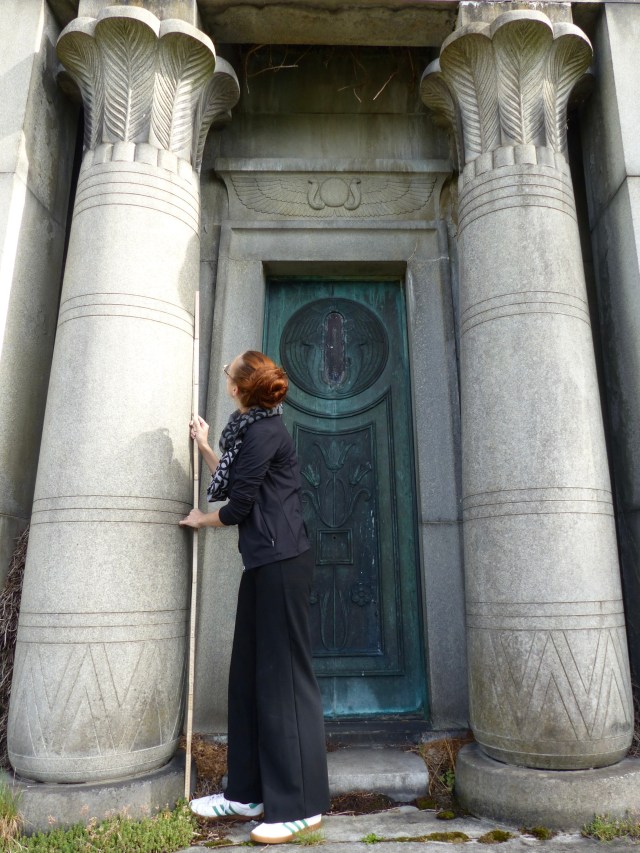
Measuring the Gordon Mausoleum in Putney Vale Cemetery.
During my brief stay in Oxford, I visited the Oxford University Archives. There, I was granted access to the Dashwood Papers, which clearly documented that John Cheere had been commissioned to create the West Wycombe Park Sphinxes. I was also able to view the deed of gift by which Henrietta Pomfret bequeathed two Neo-Egyptian sphinxes to Oxford University. Subsequently, I borrowed a large amount of secondary literature from the university’s various libraries and scanned it for later review.
In Cambridge, I visited the Anglesey Abbey estate to take measurements of the sphinxes there. This was particularly important in order to prove that they originated from the same mold as the sphinxes at Dunecht House.
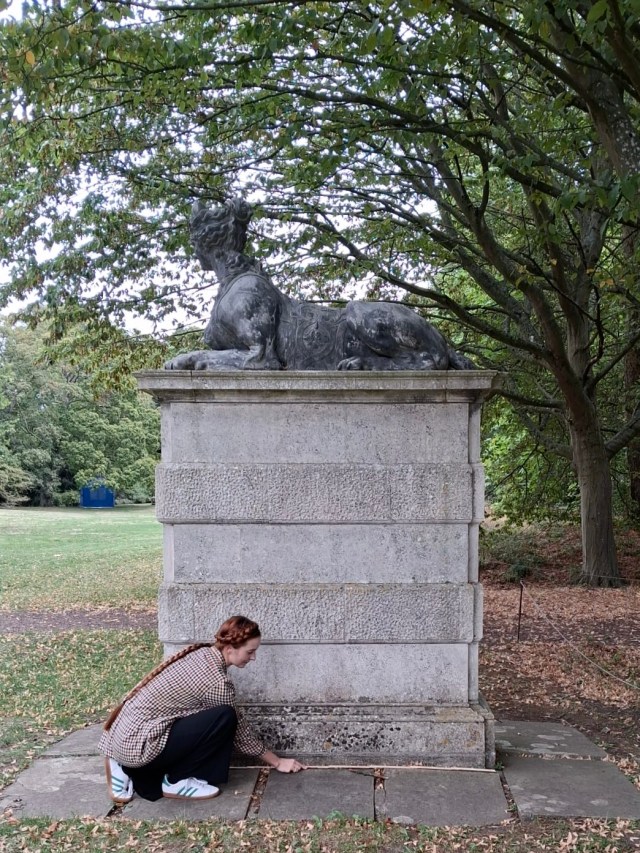
Measuring sphinxes.
I was also able to visit Castle Howard in late September. There, I documented some of the pyramidal structures that are a focus of my work. The estate’s collection of paintings featuring Egyptian-inspired themes was also very interesting.
I would like to express my sincere gratitude to the Robert Anderson Trust—and especially to Dr. Chris Naunton—for making this visit possible. I had a wonderful, productive time in London, and my work benefited greatly from the stay. I wish the Trust all the best for the future and hope that many more researchers will be able to benefit from the Visiting Scholars Program. The month in Kensington was valuable to me both academically and personally, and I can only reiterate my thanks for this opportunity.
For more information about the other students in the current cohort please see here.

