
Paige spent the month of October 2025 in London working on her research on ‘Ancient Egypt Reimagined: Exhibitionary Strategies in Redesigned Galleries’.
It is with great appreciation and gratitude that I reflect back on my residency at the Robert Anderson Trust house in Kensington during the fall of 2025. This opportunity was instrumental in providing extended time for my doctoral work and related research in London. Such dedicated support allowed for significant advancement in my research, as well as affording me the time to identify and explore new leads as they emerged over the course of my placement.
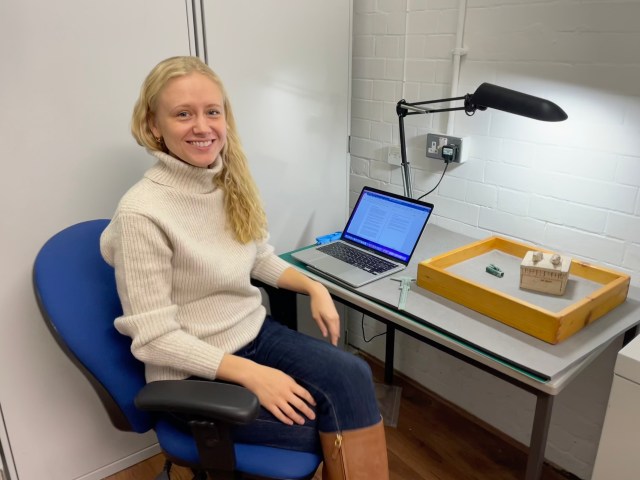
At the UCL Petrie Museum of Egyptian Archaeology with shrew Coffin UC2397
During my stay, I conducted case studies at several major museums, documenting galleries that have critically reimagined their display of Egyptian material culture over the last decade. My primary work was based at the UCL Petrie Museum of Egyptian Archaeology, whose entrance gallery was renovated in 2020 to provide expanded interpretative text on the museum’s founders and early archaeologists. Additionally, I carried out detailed object studies on a series of small shrew coffins at the Petrie Museum, including this Ptolemaic-era limestone coffin (UC2397) which once contained a pair of mummified shrews. This work is part of on-going research on animal mummy wrappings and coffins.
The Petrie Museum’s ongoing “Broken, Burnt, Buried: Ritual Lives of Objects in Ancient Egypt” show offered a practical example of rotating temporary exhibitions integrated into the existing gallery layout. Custom vinyl overlays—cut to the exact shapes of selected broken fragments—were applied over the case glass to highlight them, with accompanying labels explaining the ritual significance of breaking ancient Egyptian objects.
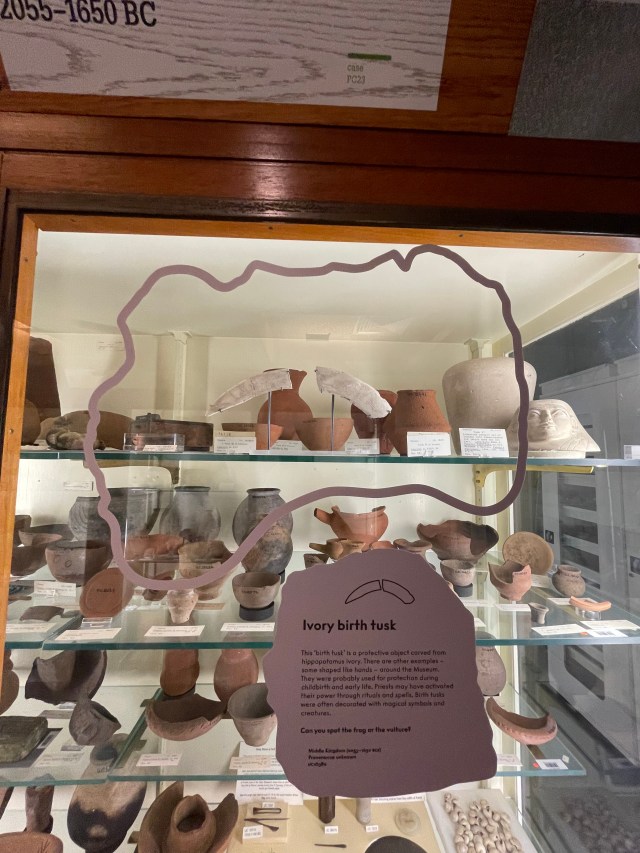
Case highlight from the Petrie Museum.
I visited several special exhibitions including “Making Egypt” at the Young V&A, “Egypt: Influencing British Design 1775-2025” at the Sir John Soane’s Museum, and “Made in Egypt” at the Fitzwilliam Museum. Applying the same analytical framework developed for my doctoral work to these exhibitions allowed me to capture otherwise ephemeral installations. I especially appreciated the “All Eyes on Her!” exhibition at The Horniman Gallery, a display which centers contemporary Egyptian women’s everyday activism as a lens to reinterpret archaeological objects from Egypt’s past. Other major case studies I completed took place at the Manchester Museum, the World Museum Liverpool, the Leicester Museum & Art Gallery, and the Bolton Museum.
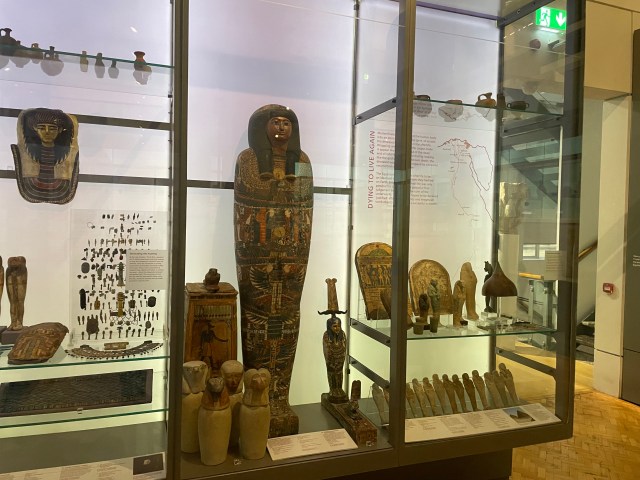
Egyptian galleries at the Manchester Museum.
Beyond collections, I guest-lectured for the Heritage Ethics and Archaeological Practice in the Middle East and Mediterranean course at University College London. Our interactive class discussed exhibitionary strategies used in contemporary displays of Egyptian and broader Middle Eastern archaeological material. I attended several IoA seminars and the British Museum’s series “Revisiting the Ancient Mediterranean World at the British Museum,” discussing planned interpretive changes in the galleries. Finally, I collaborated with colleagues on upcoming fieldwork in Egypt and participated in the “Kom al-Ahmer – Kom Wasit in Context: Exploring the Dynamics of Ptolemaic and Roman Egypt” conference.
While in London I was also invited to view the special collection of Egyptian floral remains held at Kew Royal Botanic Gardens. The collection includes wreathes, seeds, and collars from Hawara, as well as a small selection of botanic pieces from the tomb of Tutankhamun.
Overall, this focused residency considerably furthered my doctoral work. I am profoundly grateful for the on-going support of the Trust, whose sustained investment made all of this possible and I look forward to contributing to their community of scholars going forward.
For more information about the other students in the current cohort please see here.

