
Dr Wendy Doyon stayed at the Trust’s house in Kensington in August 2023 while researching a number of projects following her doctoral dissertation entitled ‘Empire of Dust: Egyptian Archaeology and Archaeological labor in Nineteenth-Century Egypt’, and afterwards provided the fascinating account of her work below.
For a full list of scholars awarded places to carry out research in London in 2023, please see here.
How many of us today remember the first post we ever made on social media? The impermanence of our digital record sticks out like a sore thumb emoji next to the archives of our predecessors, many of whose printed letters, notes, journals, and photographs have stood the test of time. With the Robert Anderson Trust’s support this year, I was fortunate to spend a very happy month immersed in such archives, mapping not only their ephemeral connections to the thoughts and feelings of archaeologists in the past, but also their physical state of existence in the present—the look, smell, feel, sound, and movement of lives lived long ago, still preserved on paper.
During my month at the Anderson Trust house in August, I visited ten different archives and museum collections in London, Oxford, and Cambridge, where I consulted many thousands of manuscript pages, photo archives, and objects pertaining to the early twentieth-century work of archaeologists Gertrude Caton-Thompson, Elinor Wright Gardner, Flinders and Hilda Petrie, T. Eric Peet, O.G.S. Crawford, Henry S. Wellcome, and several Egyptian technicians, both named and unnamed, from Quft.

After my first visit to the Pitt-Rivers Museum as a PhD student in 2013, I became intrigued by a notebook titled “Nile Valley: Gara & N. Abydos” by Elinor Gardner, which is held in the Museum’s Manuscript Collections. Ten years later I returned to the same archive as an Anderson Trust Visiting Scholar, pictured here in August 2023. Photo by Wendy Doyon.
The primary focus of this research visit was the early career of Gertrude Caton-Thompson in the field, whose first season with the Petries at Abydos during the winter of 1922, remains unpublished and little known. The work of all three archaeologists (the Petries and Caton-Thompson) and Quftis (including Mahmud Radwan) at Abydos that season proved foundational to the subsequent archaeology of the site, from the Paleolithic to Early Dynastic and Late Antique periods. In my role as a member of the Abydos Archaeology team for the Institute of Fine Arts, NYU excavations, a major aim of this research is to raise awareness of the diversity of our archaeological predecessors at Abydos as we continue to build on their work in the field.
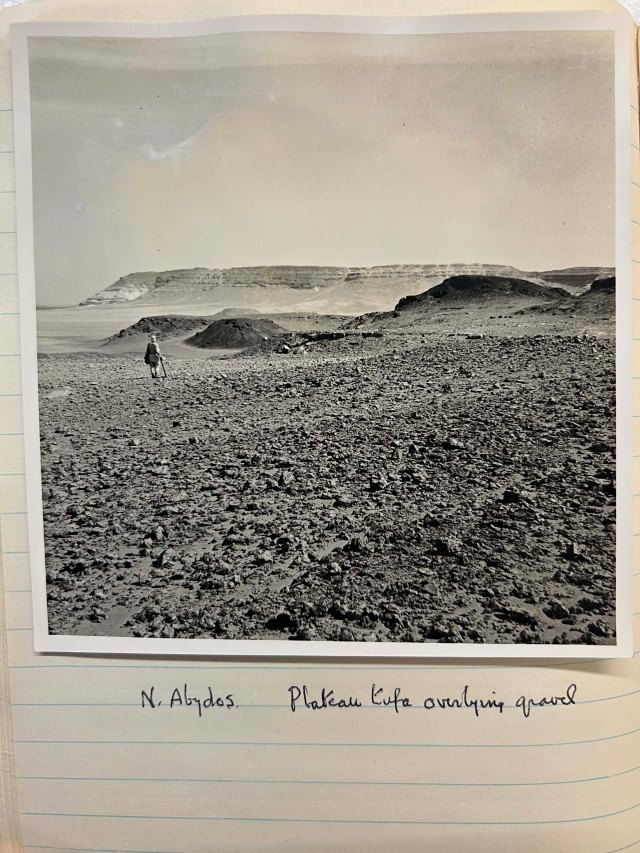
The object of my curiosity in the notebook pictured above was a 1930-33 expedition to Kharga Oasis made by Gertrude Caton-Thompson and Elinor Gardner, one of whom (unidentified) is pictured here standing on the desert plateau north of Abydos around 1930. Pitt-Rivers Museum Manuscript Collections, photo by Wendy Doyon.
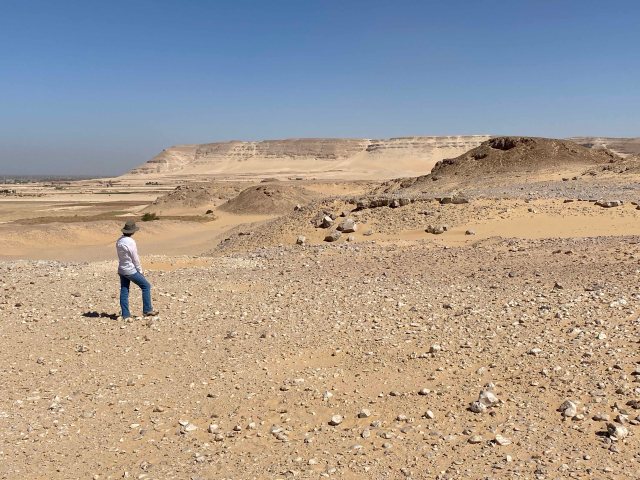
During lockdown at Abydos at the height of the pandemic in May 2020, we scouted out the location of the 1930 photograph (above), then reproduced the vantage point of the photo with Wendy Doyon standing in approximately the same spot, and from there embarked on a research project to follow in Caton-Thompson’s footsteps from Abydos through the archives. Photo by Matthew Adams.
Excavating the full extent of the field record and acknowledging diverse contributions to past work is essential to the process of making new knowledge based on previous findings. We are, for example, especially interested in building archival bridges from Petrie’s work on the “Tombs of the Courtiers” (1921-22) and T.E. Peet’s exploration of “Cemetery D” for the EES (1911-13) to NYUIFA’s ongoing excavations at the early royal monuments of north Abydos under the direction of Matthew Adams since 1999.
In a similar vein but a different role, as an historian of archaeology in modern Egypt and postdoctoral researcher in Cairo, my search also included Caton-Thompson’s work at other sites with her long-time collaborator Elinor Gardner, from the western deserts of Egypt to the Hadhramaut and Zimbabwe, as well as ongoing research on the Quftis’ work with the Wellcome Excavations in the Sudan from 1910 to 1914. Among a plethora of exciting finds, one of my favorites was opening the cover of an oversized scrapbook arranged by Caton-Thompson to find a small column of text on the first page, which began: “Not everyone who visits the exhibition of Professor Flinders Petrie’s latest discoveries of Egyptian antiquities, which opened at University College this week knows how large a share women have contributed to our knowledge of the life of Ancient Egypt…” The news clipping went on to mention the importance of her and “Mrs. Petrie’s” discoveries at Abydos that winter, a memory that the young Gertrude had clipped from the Evening News in July 1922 and pasted in the front of her scrapbook as an older, unassailably accomplished woman. It was the young Gertrude’s first social media post, happily saved by ink and paper! Her story and many others from my Trust visit this year will enrich our appreciation for the history of archaeology through a series of publications now in preparation.

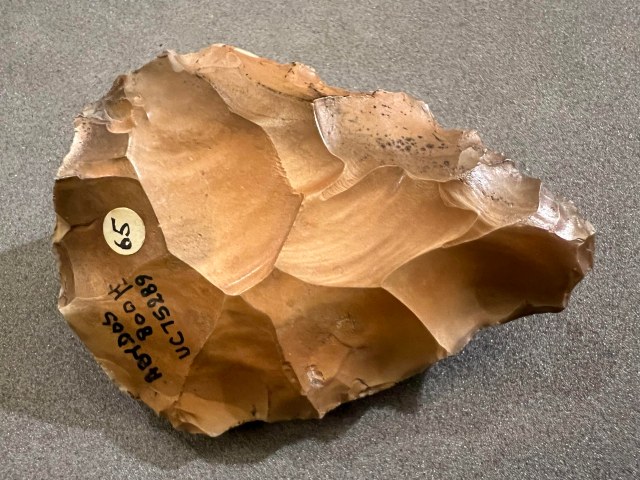
One of the most important and exciting results of this project has been to identify the extensive lithic assemblage and associated documentation that were the outcome of Caton-Thompson’s first field season as a young and aspiring archaeologist with Flinders and Hilda Petrie at Abydos in 1922. As this collection has long remained unpublished, we hope by describing her Paleolithic survey at Abydos, and its significance in launching her extraordinary career as a prehistoric archaeologist, to draw the interest of archaeologists today to her stunning—and still-unstudied—assemblage from the Abydos high desert of a hundred years ago, now housed primarily at the Petrie Museum of Egyptian and Sudanese Archaeology (with secondary components of the collection still at Abydos and museums elsewhere). Petrie Museum Collections, photos by Wendy Doyon.
 The Robert Anderson Trust